How to Build a Strong Digital Marketing Strategy from Scratch
Imagine pouring thousands of dollars into online ads, setting up flashy social media pages, and constantly tweaking your blog, only to hear absolute silence. No leads. No sales. Just the digital equivalent of tumbleweeds rolling across your screen.
Why does this happen to so many businesses? The culprit is almost always the same: building a house on sinking sand.
Too many entrepreneurs jump straight into tactics—launching campaigns, posting reels, or running PPC ads—without a blueprint. Without a cohesive Digital Marketing Strategy, you are simply guessing. And in today’s hyper-competitive online landscape, guessing is an expensive hobby.
Whether you are launching a brand-new startup or trying to breathe life into an existing business, this comprehensive guide will walk you through building a foolproof digital marketing strategy from scratch.
Step 1: Define Your North Star (Business Goals & KPIs)
Before you write a single social media caption or optimize a single page, you need to answer one fundamental question: What are we actually trying to achieve?
“Getting more customers” is not a strategy; it’s a wish. Your goals need to be specific and measurable. Use the SMART framework:
-
Specific: Do you want to increase brand awareness, drive e-commerce sales, or generate B2B leads?
-
Measurable: Tie every goal to a Key Performance Indicator (KPI). Examples include website traffic, conversion rate, customer acquisition cost (CAC), or email subscriber growth.
-
Achievable & Relevant: Align your marketing goals with your broader business capacity.
-
Time-bound: Set clear deadlines (e.g., “increase inbound leads by 25% in Q3”).
Step 2: Know Your Audience Inside and Out
You cannot market to everyone. If you try to appeal to everyone, you will resonate with no one.
To build an irresistible message, you must construct Buyer Personas—semi-fictional representations of your ideal customers. Dig deeper than basic demographics (age, location, gender). Uncover their:
-
Pain Points: What keeps them awake at night? What problem are they desperately trying to solve?
-
Goals and Aspirations: What does success look like for them?
-
Online Habits: Where do they spend their time? Are they scrolling through LinkedIn during their morning commute, searching for quick fixes on Google, or watching educational TikToks?
Once you understand their psychological triggers, your marketing will shift from talking at them to talking with them.
Step 3: Establish Your Digital Hub (Website Development & UX)
Here is a hard truth: Social media platforms are rented land. Algorithms change overnight, accounts get suspended, and organic reach plummets. Your website is the only digital real estate you truly own.
This is why foundational Website Development is the backbone of any successful marketing strategy. You can drive millions of visitors to your site, but if your platform fails, your strategy collapses.
-
Speed and Performance: If your site takes longer than three seconds to load, over half of your visitors will bounce before seeing your offer.
-
Mobile Responsiveness: With the majority of global traffic coming from mobile devices, a clunky mobile experience is an instant conversion killer.
-
Conversion Rate Optimization (CRO): Every page should have a clear purpose and a distinct Call to Action (CTA). Guide your user seamlessly from a visitor to a lead, and finally, to a paying customer.
Step 4: Choose Your Channels Wisely
With countless digital marketing channels available, spreading yourself too thin across all of them is a recipe for burnout. Instead, focus on the “Rule of Three”—pick three core channels where your target audience is most active and master them before expanding.
1. Search Engine Optimization (SEO) & Content Marketing
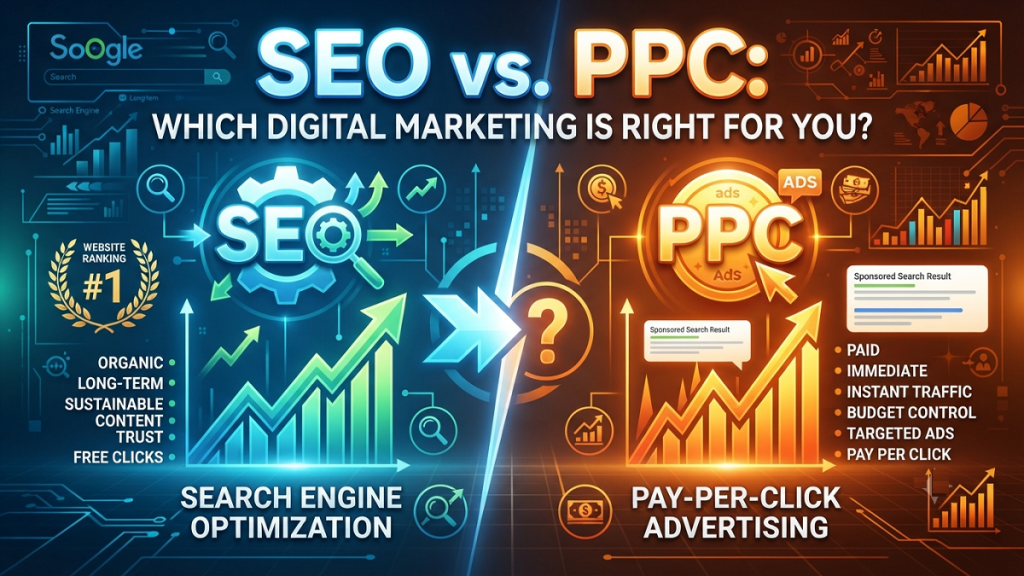
SEO is the engine of long-term, sustainable growth. By creating valuable, authoritative blog posts, guides, and landing pages optimized for search engines, you capture high-intent traffic from users actively looking for solutions you provide.
2. Pay-Per-Click Advertising (PPC)
If SEO is the long game, PPC is the accelerator. Platforms like Google Ads and Meta Ads allow you to put your brand in front of targeted demographics almost instantly, making it ideal for testing offers and driving immediate conversions.
3. Social Media Marketing
Depending on your niche, choose the right platforms:
-
B2B: LinkedIn and Twitter (X) dominate professional networking.
-
B2C / E-commerce: Instagram, TikTok, and Pinterest excel at visual storytelling and impulse buying.
4. Email Marketing
Never neglect your email list. Email consistently delivers one of the highest ROIs in digital marketing because it allows you to communicate directly with an audience that has already raised its hand and said, “I want to hear from you.”
Step 5: Craft a Compelling Content Ecosystem
Content is the currency of the internet. It builds trust, establishes authority, and nurtures prospects through the marketing funnel.
A strong content strategy follows the Hub-and-Spoke (Topic Cluster) Model:
-
Pillar Content: Create comprehensive, in-depth guides on core topics relevant to your industry.
-
Cluster Content: Write smaller, hyper-focused blog posts or social updates that link back to your main pillar page, signaling to search engines that you are an authority on the subject.
Remember to vary your content formats. Mix written articles with podcasts, infographics, video tutorials, and interactive tools to cater to different learning styles.
Step 6: Measure, Analyze, and Iterate
The digital marketing landscape is dynamic; what works today might underperform tomorrow. The beauty of digital marketing is that everything is trackable.
Implement tools like Google Analytics, Search Console, and heat-mapping software to monitor your performance metrics. Regularly review your KPIs:
-
Which channels are driving the highest-quality leads?
-
Which blog posts have the lowest bounce rates?
-
Where are users dropping off in your sales funnel?
Use these insights to pivot, optimize, and double down on what works while cutting ties with dead weight.
Final Thoughts
Building a high-performing Digital Marketing Strategy from scratch isn’t an overnight sprint—it’s a calculated marathon. By aligning your business goals, understanding your audience, investing in top-tier website development, and continuously analyzing your data, you transform marketing from a guessing game into a predictable, revenue-generating machine.
The digital world rewards those who plan with precision. Where will you start building today?